x/storage — Storage Module
The x/storage module is the lead indexer and orchestrator of the DePIN storage network. It handles storage accounting, subscription management, provider registration, file indexing, proof-of-persistence challenges, and reward distribution.
Responsibilities
- Storage accounting using byte-second credits.
- Tracking user storage subscriptions.
- Registering and managing storage providers.
- Indexing files and their replication across providers.
- Issuing and verifying proofs-of-persistence.
- Computing and distributing provider rewards.
Storage Credits
Storage is represented in units of byte-seconds. One storage credit corresponds to storing one byte for one second. This multi-dimensional representation directly couples data size with retention duration, enabling fair and granular billing.
C = S × T
Where S is the storage size in bytes (including replicas) and T is the duration in seconds.
Credit Minting
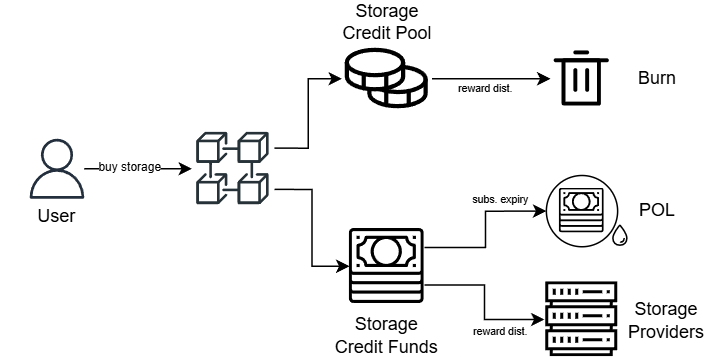
The module maintains a storage credit pool. When a subscription is created, credits representing the amount of storage for the given duration are minted in this pool. Funds used to purchase the subscription are sent to a storage rewards pool.
C = 3 × S × T
Where S is the subscription size and T is the duration in seconds. The subscription size is multiplied by 3, assuming standard 3x file replication.
Credit Allocation
Subscriptions do not hold any storager credits. They maintain a value representing their unused allocation of the credit pool.
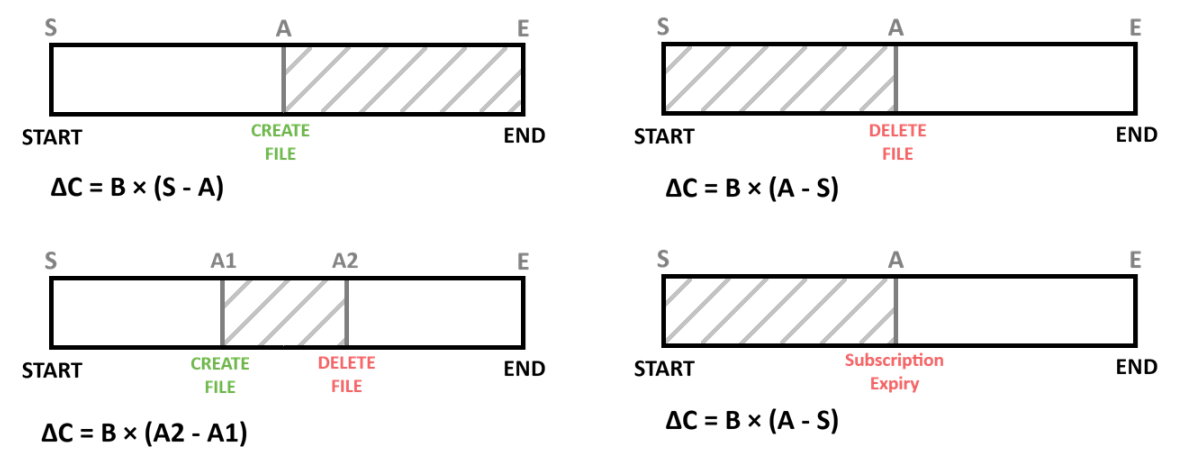
When a file is uploaded, their allocation is decremented by file_size × replicas × remaining_subscription_duration.
When a file is deleted, credits are returned proportional to the remaining subscription duration.
Upon rewards distribution, credits are not sent to the storage providers. Credits equivalent to the storage consumed for a given duration are burned, and the providers will recieve compensation in $ATL from the storage rewards pool proportional to how much data they've stored between now and the last rewards period.
A subscription is almost always going to have a residual credit allocation upon expiry. These credits are burned and their equivalent rewards are transfered to a pool of protocol owned liquidity (POL).
Summary:
- Credits are never distributed from the pool, they are allocated.
- Each subscription tracks its maximum allocation and how much has been used.
- On subscription expiry, residual credits are converted to tokens and moved to protocol-owned liquidity (POL).
Credit Manipulation
Subscriptions
Users reserve storage capacity through subscriptions. A subscription reserves a given capacity for a fixed period. Subscriptions can be purchased for oneself or on behalf of another user. Users can mark a subscription as their default. When posting files without specifying a subscription, the chain selects the default subscription or the last-purchased active subscription with available storage.
Subscription Object
message StorageSubscription {
  string id = 1;
  Timestamp start = 2;
  Timestamp end = 3;
  string status = 4;          // ACTIVE, PENDING, EXPIRED
  int64 spaceAvailable = 5;   // reserved capacity in bytes
  int64 spaceUsed = 6;        // actively used capacity in bytes
  int64 replicaSpaceUsed = 7; // space consumed by replicas
  string credits = 8;         // available storage credits (math.Int)
}
Subscription Statuses
| Status | Description |
|---|---|
| ACTIVE | The subscription is usable; new files can be posted against it. |
| PENDING | Purchased for another user but not yet accepted. Exists to prevent spam. |
| EXPIRED | The end time has passed; remains in the store for historical indexing. |
BuyStorage Message
Purchase a new storage subscription.
message MsgBuyStorage {
  string creator = 1;
  string receiver = 2;  // optional — purchase on behalf of another user
  int64 duration = 3;   // duration in seconds
  int64 bytes = 4;      // capacity in bytes
  bool is_default = 5;  // set as default subscription
}
- Standard replication factor is 3, so real allocated capacity is 3 × purchased capacity.
- At current parameters, storage costs $12/TB/month (governance-adjustable).
- The buyer must have sufficient $ATL balance at the time of transaction.
ExpandStorage Message
Extend an existing subscription in duration, capacity, or both.
message MsgExpandStorage {
  string creator = 1;
  string subscription_id = 2;
  int64 duration = 3;   // additional duration in seconds
  int64 bytes = 4;      // additional capacity in bytes
}
New storage credits are minted and the subscription's end or spaceAvailable parameters are updated accordingly.
There is no shrinking or refund policy. This is to be investigated for future releases.
Subscription Expiry
Every subscription has an End timestamp. Expiry detection and cleanup runs in the EndBlocker every block, not on-demand.
Expiry Index
An inverted keyset index (SubscriptionExpiryIndex) contains (endUnix, subscriptionId, owner), ordered by endUnix.
The EndBlocker performs a bounded scan using a PrefixUntilTripleRange(now) on this index, so only subscriptions whose endUnix has passed are iterated.
This is O(expiring subscriptions), not O(all subscriptions).
Per-Subscription Provider Byte Tracker
Each subscription maintains a SubscriptionProviderBytes map: (subscriptionId, providerAddress) → totalBytes. This tracks, per subscription, how many bytes each provider is storing on files under that subscription.
When a subscription expires, the EndBlocker's ExpireSubscriptions function:
- Iterates the expiry index to find expired subscriptions.
- For each expired subscription, iterates its
SubscriptionProviderBytesentries. - Decrements each provider's
SpaceUsedby the tracked total and removes the entry. - Applies
CreditDelta += totalBytes × (endUnix - lastRewardsTime)— compensating providers for storage served between the last reward distribution and the subscription expiry. - Removes the subscription record and its expiry index entry.
This avoids scanning every file under a subscription at expiry time, preventing the need for a file count limit on subscriptions.
Provider Space Accounting
When a file is proved (stray claim) or deleted, the module also updates SubscriptionProviderBytes synchronously:
- File proved (
AttemptAddProvider):SubscriptionProviderBytes[sub, provider] += fileSize - File deleted (
DeleteFile):SubscriptionProviderBytes[sub, provider] -= fileSize - Challenge miss (
HandleMissedChallenge, provider removed): same decrement
Lazy Per-File Cleanup
ExpireFile is called lazily from ProveFile and AttemptChallenge when they encounter a file whose subscription has expired. It compensates the provider for the pre-expiry window via CreditDelta:
- If the subscription still exists (lazy expiry before EndBlocker run),
DecrementProviderSpaceUsedis called withdelta = subscription.End - lastRewardsTime. - If the subscription is already gone (EndBlocker already handled it), the
DecrementProviderSpaceUsedcall is skipped to avoid double-decrementingSpaceUsed. - The file record is removed and
FileCountis decremented.
Residual Credit Burn
When a subscription expires, its remaining credit allocation is not refunded. The credit pool is decreased by the residual amount, and the equivalent value in tokens is transferred to protocol-owned liquidity (POL), ensuring unused prepaid storage value is not lost, but instead accrues to the protocol.
Providers
Storage providers are the backbone of the DePIN network. They commit capacity, store file data, respond to proof challenges, and earn rewards.
Provider Object
message Provider {
  string address = 1;
  string hostname = 2;
  int64 space_available = 3;  // total committed capacity
  int64 space_used = 4;       // currently utilized capacity
  int64 created_at = 5;
  int64 credit_delta = 6;     // accumulated reward delta
}
RegisterProvider Message
Register a new storage provider on the network.
message MsgRegisterProvider {
  string creator = 1;
  string hostname = 2;
  int64 capacity = 3;
}
UpdateProvider Message
Update a provider's hostname or capacity.
message MsgUpdateProvider {
  string creator = 1;
  string hostname = 2;
  int64 capacity = 3;
}
The creator must have at least 10'000 $ATL available in their wallet to update a provider. This amount is held as a security deposit and is returned in full when the provider is sunsetted (removed from the network).
Files
Files are indexed in the key-value store under the prefix files/<creator_address>/<subscription_id>/<file_id>.
File Object
message File {
  string fid = 1;            // file identifier
  string merkle = 2;         // merkle root hash
  string creator = 3;        // creator wallet address
  string subscription = 4;   // associated subscription ID
  string status = 5;         // STAGED or ACTIVE
  int64 file_size = 6;
  int32 replicas = 7;
  repeated string providers = 8;           // confirmed providers
  repeated string unstable_providers = 9;  // providers still proving
  int64 start = 10;                         // creation block height
}
File Identification
The file ID (FID) is a SHA-256 hash of:
<merkle_root>:<creator_address>:<de-duplication_index>
The de-duplication index prevents collisions when a user uploads identical copies of the same file and is calculated by the client.
PostFile
Submit a file to the network.
message MsgPostFile {
  string creator = 1;
  string fid = 2;
  bytes merkle = 3;
  int64 file_size = 4;
  int32 replicas = 5;
  string subscription = 6;
}
- The client builds a Merkle tree of the file divided into 1 KiB chunks.
- A
PostFilerequest is broadcast, submitting the metadata and Merkle root. - The file status is set to STAGED and the subscription's space used is incremented.
- The client uploads the file data directly to a storage provider.
- The provider submits a proof for the first chunk to attest receipt and capability.
- On valid proof, the provider is added to the file's provider list. The status becomes STRAY while the file awaits additional replicas. Once enough providers have proven the file to meet the replica requirement, the status transitions to ACTIVE.
DeleteFile
Remove a file from the network.
message MsgDeleteFile {
  string creator = 1;
  string file_id = 2;
}
Remaining storage credits are computed and re-allocated to the subscription. The subscription's space used and the provider's storage usage are decremented.
File Statuses
| Status | Description |
|---|---|
| STAGED | Submitted on-chain but not yet proven by any provider. |
| STRAY | Proven by at least one provider but has not yet reached the required number of replicas. Awaiting additional providers to pick up the file. |
| ACTIVE | Fully replicated — the required number of providers have proven the file. |
| DEAD | All providers that held the file have failed their proof challenges and no provider carries the file anymore. The file is considered lost. |
Proof of Persistence
Atlas Protocol uses a deterministic challenge mechanism to verify that providers are actually storing the files they claim to hold.
Merkle Tree Construction
A two-layer hybrid hash scheme is used:
- Leaf hashes: Blake3 cryptographic hash of each 1 KiB data chunk.
- Internal nodes: XXH3-128bit non-cryptographic hash.
Challenge Structure
message StorageChallenge {
  string challenge_id = 1;
  string file_id = 2;
  string file_merkle = 3;
  string provider = 4;
  uint64 chunk_index = 5;
  uint64 created_height = 6;
  uint64 deadline_height = 7;
}
Challenge Windows
Time is divided into proof windows of fixed block length (ProofWindowBlocks). Each window is further divided into proof rounds of fixed block length (ProofRoundBlocks). Every round, a batch of files is selected for challenge using an iteration cursor that advances through the file index.
Window initialization (StartChallengeWindow):
- Called once per window boundary.
- Takes a snapshot of the current total file count — this frozen count determines how many files are eligible across all rounds in the window.
- Resets the iteration cursor to the start position.
Cursor Direction alternation:
- Even-numbered windows iterate ascending through the file store.
- Odd-numbered windows iterate descending.
- This ensures files at the edges of the key space are not systematically skipped across consecutive windows.
Round processing (StartChallengeRound):
-
Computes how many files to challenge this round using an equation to distribute the total load evenly:
filesThisRound = (N × R × (round + 1) + W - 1) / W - (N × R × round + W - 1) / WWhere
N= total eligible files,R=ProofRoundBlocks,W=ProofWindowBlocks. -
Iterates through the file store starting from the last cursor position, collecting
filesThisRoundeligible files (skippingSTAGEDandDEADfiles). -
For each eligible file, a challenge is issued to every provider currently holding that file.
-
Updates the cursor to the last processed file so the next round continues from where it left off.
Challenge generation (IssueChallengeForFile):
For each provider of a file, the challenged chunk is selected deterministically:
seed = prevBlockHash || file.Fid || round || providerPosition
chunkIndex = XXHash(seed) % totalChunks
- The hash of the previous block provides on-chain entropy.
- Each provider within a file is challenged on a different chunk.
- The challenge has a
DeadlineHeightofcurrentBlockHeight + ProofRoundBlocks.
Missed challenge handling (HandleMissedChallenges):
At the end of each round, all active challenges are checked against their deadline:
- If a provider fails to respond before the deadline, their used space is decremented with a double-time penalty.
- If this is the first miss for this provider+file pair, the provider is placed in the file's
UnstableProviderslist as a warning. - If the provider misses again while already unstable, they are removed from the file entirely.
- If this was the last provider for the file, the file's status becomes DEAD.
Proving a File
message MsgProveFile {
  string creator = 1;
  string challenge_id = 2;
  string fid = 3;
  bytes data = 4;          // the challenged chunk data
  repeated bytes hashes = 5;  // Merkle sibling hashes
  uint64 chunk = 6;
  uint64 path = 7;         // path bits for unbalanced tree
}
Rewards Distribution
At the end of each proof round, provider rewards are computed and distributed. The mechanism is driven by:
LastRewardsTime — Tracks the last block timestamp when rewards were distributed. On first initialization it is set to the current block time and distribution is skipped.
StorageCreditPool — The total pool of outstanding storage credits held by the module. Provider rewards are a proportion of this pool.
CreditDelta — Each provider carries a CreditDelta that accounts for space changes between reward rounds. When a provider's space used changes mid-round (files added or removed), the delta captures the difference so the next reward calculation remains accurate.
Reward Calculation
For each provider, earned credits are computed as:
credits = Δt × spaceUsed + creditDelta
Where Δt is the time elapsed since the last distribution. If credits is negative (e.g. from a CreditDelta carryover), the negative value is forwarded to the next round and no distribution occurs for that provider.
Provider tokens are then distributed proportionally from the module's token balance:
tokens = poolTokens × credits / totalPoolCredits
Stray Files
At the end of each reward round, rewards that would have been paid for STRAY files (files that haven't reached full replication) are redirected to protocol-owned liquidity (POL) instead of any specific provider.
Queries
Stats Queries
| Query | Endpoint | Returns |
|---|---|---|
StorageStats | /atlas/storage/v1/storage_stats | Network-level aggregates: subscription count, space purchased, space used, replica space, provider count, space available |
FileStats | /atlas/storage/v1/file_stats | Total files, stray files, and dead files |
Provider Queries
| Query | Endpoint | Description |
|---|---|---|
Provider | /atlas/storage/v1/provider/{address} | Single provider by address |
Providers | /atlas/storage/v1/providers | List all registered providers |
File Queries
| Query | Endpoint | Description |
|---|---|---|
File | /atlas/storage/v1/file/{fid} | Single file by FID |
Files | /atlas/storage/v1/files | Paginated files by creator and subscription |
Strays | /atlas/storage/v1/strays | Files needing additional replicas |
Subscription Queries
| Query | Endpoint | Description |
|---|---|---|
Subscription | /atlas/storage/v1/subscription | Single subscription by address and ID |
Subscriptions | /atlas/storage/v1/subscriptions | All subscriptions for an address |
Challenge Queries
| Query | Endpoint | Description |
|---|---|---|
Challenges | /atlas/storage/v1/challenges | Challenges for a provider, paginated |